
Interactive neuroscience · Drosophila melanogaster
Fruit fly brain simulator
What happens between seeing a fast-approaching object and taking off? Cast a shadow in NeuroCause and follow the fruit fly’s escape circuit, from visual input to simulated spikes.
Try the simulation · Read the methods
Try one stimulus
- Start the guided tour for an introduction. To run this trial directly, choose Watch the fly under Explore on my own. Wait until the fly is on the ground.
- Choose Cast a shadow below the terrarium. Read the observation next to the controls. Record whether you saw a takeoff, a dart on foot or no matching response.
- Open See why when a response is recorded. For a takeoff, use Slow motion in the explanation to inspect the simulated spikes.
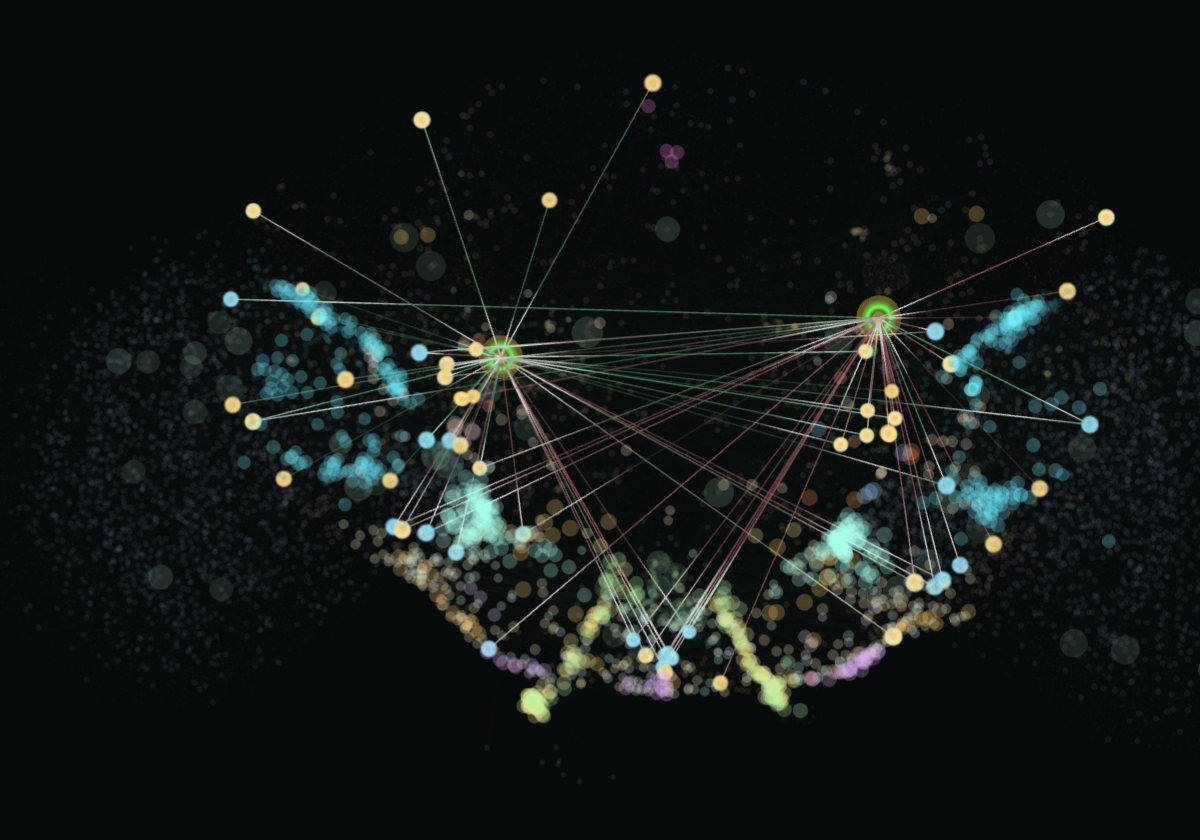
Compare vision with taste
After the fly has settled, select Offer sugar. Look for an extension of the proboscis, the fly’s feeding organ. Repeat both trials and write down the initial behaviour and your result each time. Compare responses at the same simulation speed.
The controls send inputs to the simulation. The observation is a behavioural event that follows an input in the current run. The explanation shows the available model trace for that event.
What comes from a real fruit fly brain?
A connectome is a map of neural wiring. Electron microscopy lets researchers reconstruct neurons and identify synaptic contacts. NeuroCause uses published connections to build circuits; membrane dynamics, sensory inputs and the body are modelled. A response is an observation about this simulation. It does not establish how a living fly would react or whether the model feels anything.
For the original adult brain reconstruction, see Dorkenwald et al., Nature (2024). For the specific datasets, coverage and model assumptions in this implementation, see the methods, evidence and technical report.
Where to go next
Care for a virtual fly in Habitat or open the experiment workspace. The browser simulator is free to use without an account. It runs on your device and requires WebGL 2.